Municipal Art Gallery of Corinth
The exhibition offers a conceptual reading of the historic Battle of Thermopylae, exploring the conflict between two opposing worlds and highlighting the dialectical relationship that emerged as the condition through which the necessary balance between opposites is achieved. This relationship establishes the space within which the ideals capable of leading civilization to its highest point can develop.
Participating Artists:
Kyra Aligizaki, Ioannis Argyropoulos, Ioannis Koutrozis,
Nikolas Kyriakou, Chrysanthi Maggidis, Eleanna Martinou, Kostas Tsironis
Curator: Konstantinos Bourazanis
Recitation of the Oracles: Fotini Fyka
Lighting: Stella Kaltsou
Graphic Design: Stelios Blentzas
Sound: Akis Loukas
“KATHARSIS”
Historical Information Centre of Thermopylae
31 August – 10 September 2023
Thermopylae, a place of morals, ideals, and heroism, remains a living cell of modern society. It teaches us the power of will and faith, demonstrating how the few can stand against the many. This is the historical truth embodied in the Battle of Thermopylae, which succeeded in highlighting the strategic superiority of the Greeks despite the overwhelming numerical superiority of the Persians.
A place that continues to emanate courage and heroism, Thermopylae 2023 has the honour of hosting an inspiring exhibition of contemporary art in this historic landscape. Katharsis brings a modern aura to a place whose history has continued to inspire throughout the centuries. By showcasing the possibilities of contemporary artistic expression, the exhibition aspires to offer an alternative experience of viewing and interpreting the historical landscape, encouraging reflection and allowing for multiple interpretations.
The strength and confidence of the artists’ individual styles, together with their contemporary approach to history, become a source of inspiration for visitors to explore their own thoughts and engage with their inner selves through what might be described as the most beautiful form of disorder. Concepts such as space, time, culture, history, and art are inextricably linked and acquire a contemporary identity when viewed through the prism of one another.
As contemporary art assumes an increasingly important role in revitalising historical places through the creation of new experiences and perspectives, exhibitions presenting works of high aesthetic value—works that reinforce and illuminate the historical and cultural heritage of a place—should remain a priority and receive our continued support. For history, as the repository of human experience and self-knowledge, cannot but remain eternally contemporary.
The Mayor of Lamia
Efthymios K. Karaiskos
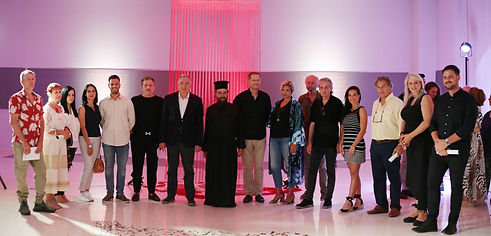
Opening Night
The exhibition will open on Thursday, 31 August at 8:00 p.m. at the Historical Information Centre of Thermopylae and will run through 10 September.


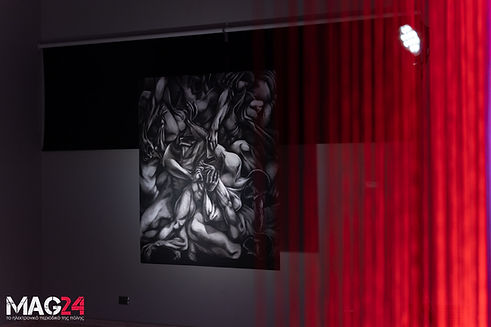
Ή ΤΑΝ Ή ΕΠΙ ΤΑΣ
The artwork measures 1.80 × 1.50 m, is executed in charcoal on paper, and was created in 2023.
The title of the work, Ή ΤΑΝ Ή ΕΠΙ ΤΑΣ—“With it or on it”—derives from the ancient Spartan exhortation traditionally associated with mothers sending their sons to war: to return carrying their shield, or to be carried home upon it. The phrase encapsulates an uncompromising expectation of courage, duty, and honour. For the soldier, there is no acceptable alternative between victory and death; the shield becomes a symbol of both survival and sacrifice. Beyond its historical context, the expression reveals the psychological weight of the expectations imposed upon those who enter war—the obligation to fulfil a prescribed ideal of strength regardless of fear, suffering, or the human cost.
The artwork translates this pressure into a visual language of physical and psychological disorientation. Bodies overlap, intersect, and become entangled within the composition, making it deliberately difficult to determine where one figure ends and another begins. The viewer is compelled to search for connections between limbs and bodies, only to encounter an unstable field in which individual identities are gradually dissolved. There is deliberately no clear distinction between the living and the dead; instead, all bodies participate in the same visual turmoil. This ambiguity reflects the chaos of war, where individuality, order, and certainty can be overwhelmed by violence and collective suffering.
The composition is therefore not intended to narrate a particular moment of battle, but to evoke the psychological experience of being absorbed into it. The fragmented and overlapping figures suggest both the physical devastation of conflict and the loss of individual agency that accompanies it. The human body, ordinarily a recognizable marker of identity, becomes fragmented and difficult to read, mirroring the way war disrupts the boundaries between self and other, life and death, courage and vulnerability.
The work is also informed by the dark and disorienting world of Dante’s Inferno, particularly its conception of a space in which bodies, suffering, and psychological torment coexist within an atmosphere of confusion and darkness. This influence contributes to the work’s sense of an almost infernal landscape, where conventional distinctions and hierarchies collapse. Within this visual chaos, Ή ΤΑΝ Ή ΕΠΙ ΤΑΣ confronts the ideals of honour and sacrifice embodied by its title with the corporeal and psychological reality of war, asking what remains of the individual when the expectations placed upon the soldier become indistinguishable from the destruction they demand.
